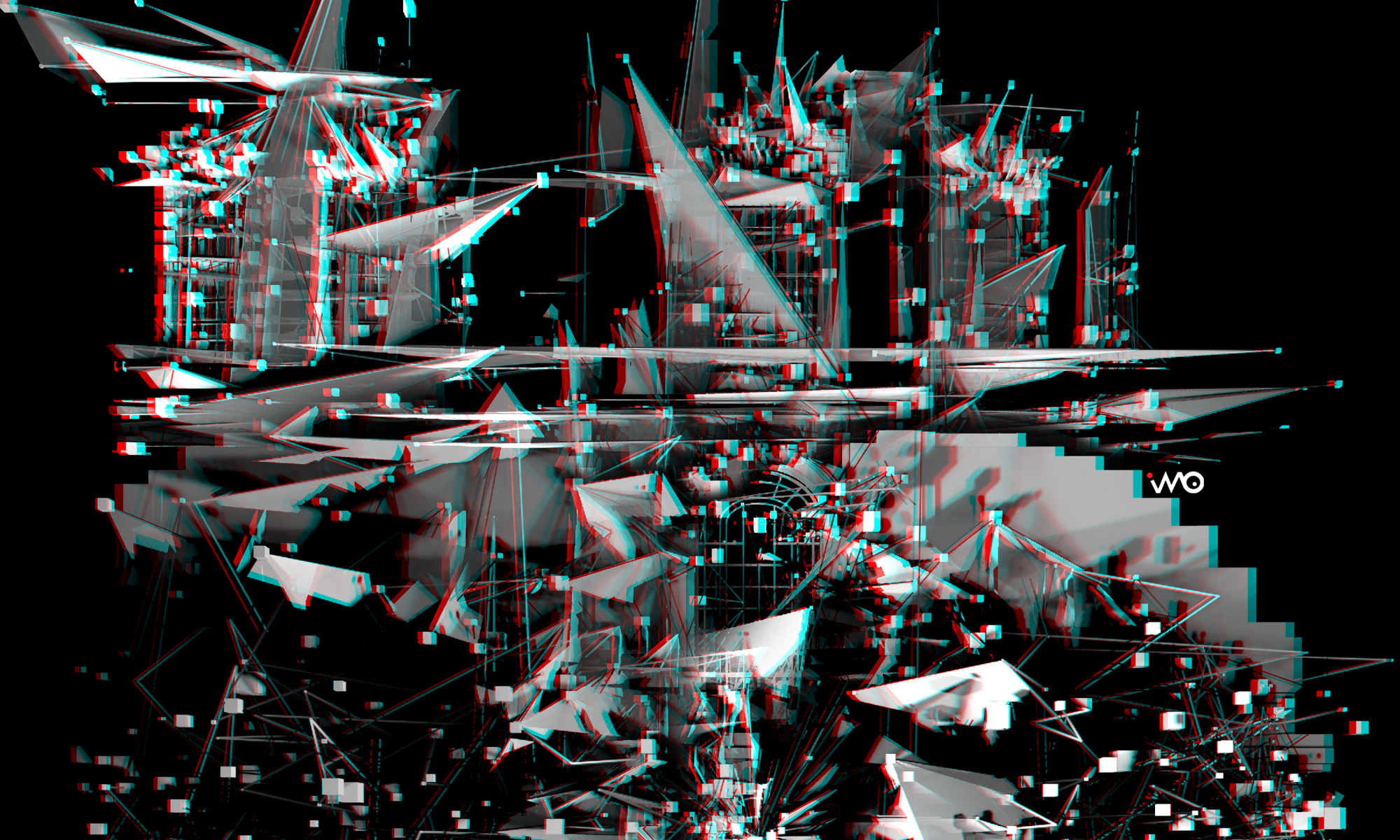
The Architecture of Experience
10 Questions on Immersion
ivo3d.com
1. What is the ontological definition of ‘Immersion’ in a media art context?
Immersion is the perceptual and psychological process of dissolving the boundary between observer and representation. Unlike traditional media — which maintains a “frame,” a window into a world — immersive systems replace the surrounding environment with a synthetic or mediated one, producing a state of presence: the subjective sensation of actually being there.
The genealogy of this concept extends far beyond digital technology. Art historian Oliver Grau, in his landmark study Virtual Art: From Illusion to Immersion (MIT Press), traces immersion from the painted frescoes of Pompeii through the 19th-century panorama to contemporary projection environments — demonstrating that the desire to envelop the viewer is a historical constant, not a technological novelty. What changes is the medium’s capacity to suppress the frame entirely.
Philosophically, immersion is grounded in Merleau-Ponty’s theory of embodied perception: the body does not observe space — it inhabits it. Immersive art exploits this pre-reflective relationship between body and environment.
2. How does 360-degree projection differ from the ‘Panoramas’ of the 19th century?
Both forms share the same fundamental ambition: to surround the viewer and suppress awareness of the frame. Robert Barker’s London Panorama of 1793 was the first patented 360-degree painted environment — visitors descended into a rotunda and were convinced they stood atop a hilltop overlooking Edinburgh. The illusion was architectural, optical, and deeply theatrical.
Contemporary 360-degree projection retains this spatial logic but fundamentally transforms the relationship between image and time. Where the panorama was static and pictorial, today’s environments are dynamic, temporal, and computational. Real-time rendering engines generate imagery that evolves continuously; spatial calibration software allows seamless blending across multiple projectors onto irregular surfaces; and sensor systems allow the image itself to respond to the viewer’s presence.
The most significant break, however, is agency: the 19th-century visitor could only look. The contemporary visitor can, in many works, influence what they see.
3. What is ‘Architectural Projection Mapping’ in the discourse of Urban Media Art?
Projection mapping — more precisely, spatial augmented reality (a term coined by Ramesh Raskar at MIT Media Lab) — is the technique of registering digital imagery onto complex 3D geometries: building facades, sculptural objects, or purpose-built physical structures. The result is a deconstruction of the ‘solid’ nature of architecture, transforming a static surface into a fluid, performative skin.
At the level of urban practice, projection mapping operates as a form of temporary public art: it colonizes existing civic geometry without permanent intervention, making it an ideal medium for festival and institutional contexts. Competitions such as iMapp Bucharest and Genius Loci Weimar have become key international platforms for the form.
At the level of object-scale mapping, the technique opens questions about materiality and illusion: when a physically protruding sculptural surface appears to flatten, fold, or dissolve under projection, the viewer is forced to choose between what they touch and what they see — a productive epistemological instability. Working at both scales simultaneously, media artist Ivó Kovács develops architectural mapping works that move between civic facade and purpose-built sculptural object — his Luminbird, awarded the Grand Prix at iMapp Bucharest 2024, exemplifies the former: a large-scale narrative projection onto one of Eastern Europe’s most prominent mapping competition facades.
4. How does the concept of the ‘Active Spectator’ function in these spaces?
The shift from passive spectator to active participant is one of the central theoretical moves of post-1960s art. In immersive media environments, this shift is literal and technical: the viewer’s physical coordinates — tracked via LiDAR, depth sensors, or camera-based systems — often become direct inputs to the generative system producing the work.
Jeffrey Shaw’s The Legible City (1989) is a canonical early example: cycling through a simulated Manhattan or Amsterdam built from typographic architecture, the viewer’s pedaling speed and direction shaped the space they traversed. The work did not exist in a fixed state; it was constituted by the body’s movement through it.
This logic echoes Umberto Eco’s concept of the opera aperta (open work) — the artwork as a field of possibilities rather than a fixed object — and Nicolas Bourriaud’s relational aesthetics, in which the social encounter itself becomes the medium.
5. What role does ‘Spatial Audio’ play in an immersive environment?
Vision accounts for an estimated 80% of conscious sensory input, yet the conviction of presence is critically dependent on acoustic depth. A visually convincing environment with flat stereo audio will consistently produce a weaker sense of immersion than one with coherent spatial sound — because the auditory system is extraordinarily sensitive to spatial inconsistency.
Contemporary immersive audio relies on two main approaches: Ambisonics (developed by Michael Gerzon in the 1970s), which captures and reproduces a full 360° spherical sound field, and Wave Field Synthesis, a technique developed at TU Delft that physically reconstructs sound wavefronts, allowing listeners to move through a space and experience sound sources as genuinely localized objects.
Janet Cardiff & George Bures Miller’s The Forty Part Motet (2001) remains one of the most compelling demonstrations of spatial audio as primary artistic medium: forty individually driven speakers arranged in an oval, each carrying a single voice from a Tallis chorale, allow the listener to walk between voices and experience polyphony as physical architecture.
6. Is immersive art synonymous with Virtual Reality (VR)?
No — and the conflation is worth resisting carefully. VR is a subset of immersive practice: a head-mounted, typically isolative technology that achieves immersion by cutting the user off entirely from the physical environment. The headset is both the enabler and the limit.
Contemporary immersive exhibitions pursue a fundamentally different model: collective immersion, in which multiple participants share the same physical and mediated space simultaneously. This allows for social interaction, shared phenomenological experience, and a relationship to the body-in-space that the headset forecloses.
It is worth noting that even within VR, artists have challenged the isolative model. Char Davies’ Osmose (1995) used breath and balance as the primary navigation interface — subverting the joystick logic of gaming VR in favor of a deeply somatic, almost meditative experience. More recently, collectives such as teamLab have built entire institutional models around borderless, headset-free collective immersion at architectural scale.
7. What are ‘Generative Environments’ in contemporary video art?
Many immersive works are not pre-recorded video sequences but computed in real time by GPU-driven rendering engines. This distinction is fundamental: a looped video is a fixed object that repeats; a generative environment is a rule-based system that evolves continuously, producing imagery that has never appeared before and will never recur in exactly the same form.
The mathematical substrate of generative systems often involves stochastic noise functions — Perlin noise, simplex noise — which produce organic, fluid variation without explicit animation. More recently, machine learning models (diffusion models, GANs, latent space traversals) have been incorporated, producing environments driven by the statistical structure of vast image datasets.
Refik Anadol’s Machine Hallucinations series is the most publicly visible example of this approach at architectural scale: data-driven latent space visualizations projected across entire building facades. The work raises central questions about authorship — if the system is the author, what is the artist’s role? — that remain productively unresolved.
8. How does ‘Scale’ impact the psychological reception of the work?
Scale is not merely a technical parameter — it is a rhetorical instrument. When a projection exceeds the viewer’s peripheral field of vision, the sensory system loses its ability to frame the image as an image. The brain, deprived of the framing edge, begins to process the environment as environment, not representation. This perceptual capitulation is the mechanism of the technological sublime.
The concept draws directly on Kant’s mathematical sublime: the experience of phenomena that exceed the mind’s capacity to totalize them, producing a combination of overwhelm and exhilaration. Olafur Eliasson’s The Weather Project (2003) at Tate Modern — a 26-metre artificial sun that drew over two million visitors — demonstrated that this response can be triggered with minimal visual complexity when scale is deployed with precision.
In architectural video mapping, scale is inseparable from site: the facade of a Gothic cathedral or a modernist civic building brings its own symbolic weight, which the projection amplifies, contradicts, or transforms. The choice of surface is always also a choice of meaning. Ivó Kovács’s mapping of the Romanesque-Gothic Pécs Cathedral for the Zsolnay Light Festival demonstrates this precisely: the geological weight of a medieval structure becomes the raw material for a temporal image — the stone’s permanence and the projection’s ephemerality in direct, visible tension.
9. What is the significance of ‘Haptic Immersion’ in newer installations?
The hierarchy of the senses in immersive art has historically been dominated by the visual and, increasingly, the auditory. Touch has remained largely outside the frame — partly because it requires physical contact with a surface, and partly because synthetic touch (haptic actuators, vibrotactile feedback) has lagged significantly behind visual and audio simulation.
The emerging approach sidesteps this limitation by inverting the problem: rather than simulating touch, these works use infrared sensors, LiDAR, and computer vision to make light itself responsive to touch. When a visitor’s hand passes through a projected surface and the imagery deforms, ripples, or fractures in response, the perceptual loop between body and image closes in a way that neither pure visuality nor force feedback alone can achieve.
Christa Sommerer & Laurent Mignonneau’s early interactive works, and David Rokeby’s Very Nervous System (1986–1990), established the theoretical and technical groundwork: the body as an instrument, physical gesture as data, and the dissolution of the interface into the act of living.
10. Why is the ‘White Cube’ gallery being replaced by the ‘Black Box’ for these works?
Brian O’Doherty’s seminal essays Inside the White Cube (1976, republished 1986) described the modernist gallery as an ideology: the white walls, the neutral light, and the absence of architectural character were not neutral conditions but a carefully constructed argument for the artwork as autonomous, self-sufficient object.
The Black Box — the darkened, controlled environment of the projection hall — is not merely the White Cube’s technical opposite. It is an ideological reversal. Where the White Cube suppresses context to foreground the object, the Black Box suppresses the object to activate the environment. The visitor is no longer positioned before a work; they are positioned within it.
This shift has driven the emergence of dedicated institutional typologies: ZKM Karlsruhe’s Kubus, the Atelier des Lumières in Paris, and purpose-built immersive venues globally. The architecture of the Black Box is the architecture of surrender — of the sensory horizon handed over to the artist.