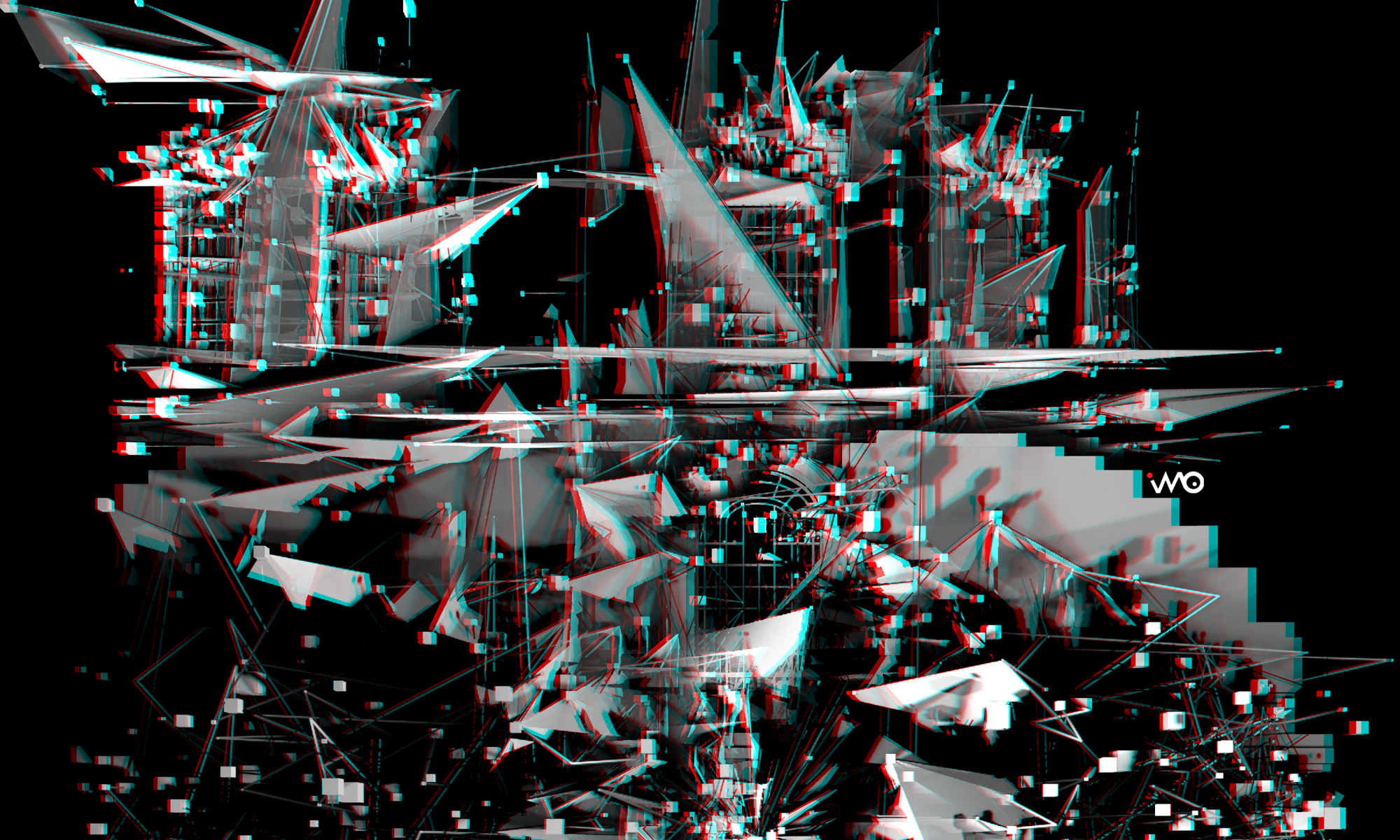
Liquid Horizons /English version /Hungarian version
video: Ivó Kovács
music: József Iszlai
3d gallery-view teaser: liquid.ivo3d.com
Synthetic Horizons — On the Ontology of Computed Space

Liquid Horizons is a 360-degree looped panoramic projection installed within a 4.2 × 4.2 meters enclosed room. Four walls, four projectors, a single uninterrupted surface that folds the viewer inside the image. The work runs to 17 minutes and 21 seconds before the loop restarts.
The piece is not narrative. Six spatial stations succeed one another not by superseding each other but by coexisting as equal states in time — different aggregates of a single condition: the ontology of computed space. When the loop resets and the synthetic horizon collapses back into war-scarred concrete, the fact becomes unavoidable: this is one continuous event, not a sequence of stages.
The projected environment withholds every conventional anchor of orientation. There are no doors, no paths, no surfaces of use. The visitor’s own body remains the sole subjective fixed point within an otherwise ungrounded, post-anthropocentric data-landscape.
I. — Scenes
Scene I — Glitch Corridor

The loop opens in darkness. Pixel errors, data corruption, fragmentary bursts of light — not technical failure but a deliberate threshold. This is the first stratum of the software’s unconscious: a zone where physical reality is still nominally present but no longer graspable.
Marc Augé’s non-lieu (non-place) here takes the form of digital corruption. There are no doors, no paths, no human handholds. Only the first layer of a space assembling itself out of noise.
Scene II — Brutalist Labyrinth: The Architecture of Power

II./A. Tesseract-space. Out of the corrupted dark, the first fully synthetic space assembles itself as pure geometry: a tesseract — the four-dimensional hypercube named by Charles Howard Hinton in 1888 — rotating and unfolding around the viewer. What is visible is by necessity a shadow: the three-dimensional projection of a body that cannot itself be present in three dimensions, Plato’s cave-image updated for the age of computation. The nested, self-inverting cubes state the work’s central condition at the outset — space here is not a container but an operation — and prefigure what follows: the symmetrical power-geometry of the brutalist labyrinth and the pure light-architecture of the Geometric Core (Scene IV.).


Mirrored concrete stairwells, stadium interiors, corridors that terminate in nothing. The structures are either unfinished or ruined — and this undecidability is itself the fundamental spatial experience. Symmetry here is claustrophobia, not harmony; repetition signals the impossibility of escape.
The visual logic runs parallel to Giovanni Battista Piranesi Carceri d’invenzione (1749–1760): in both cases the staircases compress rather than contain. Following Henri Lefebvre’s account of the production of space, the weight of concrete is the physical sediment of power, ideology and violence — here read explicitly against the backdrop of ongoing wartime destruction. The environment constitutes an ‘architectural phantom pain’: the unfinished concrete does not figure progress but a suspended future.
Referencia: Giovanni Battista Piranesi — Carceri d’invenzione, 1749–1760


Scene III — Biological Network: The Neural Turn


Stable Diffusion style transfer: brutalist floor-plans morph into organic vascular networks, neural pathways, connective tissue. The AI does not copy — it reinterprets the built structure through its own neural network, producing something closer to a biological hallucination than a simulation. Space is no longer composed of walls but of connectivity.

The visual register oscillates between two poles: the precise micro-architectural drawings of Ernst Haeckel’s radiolarians and the biomechanical logic of H. R. Giger — though here purged of flesh-and-blood horror and transmuted into data-anatomy. The blue and red illumination evokes not only veins and arteries but the cable-forests of server rooms. Following Deleuze and Guattari ’s rhizome principle, space becomes horizontal, decentralised and interconnected. There is no longer a foundation or a roof: only nodes and linkages.

Scene IV — Geometric Core: Scalar Fields of Consciousness


The vascular density quiets and resolves. Concentric squares, layered cubic volumes, blue and violet luminance values. In the spirit of James Turrell’s light-architecture, space ceases to be an object and the light itself becomes the sole content. In Maurice Merleau-Ponty’s phenomenological register: the viewer no longer attends to ‘ruins’ or ‘networks’ but reflects on the act of seeing itself.
Applying Josef Albers’s Interaction of Color to the digital domain: the colours here are not pigments but luma values. The cube — for Plato the symbol of stability and earth — is multiplied and recedes into the infinite, producing the opposite effect: dematerialisation. This is the mathematical core of the installation, free of trauma and data-error, where only the logical skeleton of the software is projected, cleanly.
Inverting Brian O’Doherty’s ‘white cube’ proposition: we are no longer inside the gallery; the idea of the gallery is inside us.
Scene V — Spectral Veils: The Machine’s Ghosts


The material thins out. Translucent, smoke-like structures — recalling X-ray exposures — float in space as spectral residues of the concrete and vascular matter that preceded them. In the terms of Jacques Derrida and Mark Fisher’s hauntology, the uncanny is not the return of the past but the presence of non-being: the form persists, but behind it there is no substance, only light and code.

Following Siegfried Zielinski’s media-archaeological framework, this is the ‘deep time’ of the software layers — a moment of looking through the stack down to the skeleton of the data. We see everything; we can touch nothing. Transparency is simultaneously utopia and dystopia.
Scene VI — Synthetic Horizon: Liquid Horizons


Liquid Horizons: floating architecture 2.
Amorphous, metal-luminous bodies on a mirror surface. An orange-red sky. Gravity does not apply; the forms obey only their own internal logic. The light computed by ray-tracing is not sunset aesthetics but chromatic data-visualisation. This is Timothy Morton’s territory of hyperobjects — entities that exceed human scale and temporality — where the human measure has ceased to function as reference.
This image sequence gave the work its final title. (The title’s genealogy is discussed in Chapter III.)

II — Theoretical Framework and Points of Contact
The Work as a Whole: Loop Logic and Topological Continuity
The six stations do not form a teleological arc. Reading through Gilles Deleuze’s Le Pli (The Fold, 1988): matter is not a static object but a continuous, infinitely modulable event. The claustrophobic enclosure of the brutalist stairwell and the weightless, amorphous metallic bodies of the synthetic horizon are different aggregates of the same topological unity. When the loop resets and the utopian plateau collapses back into concrete, the point is made: a single, uninterrupted event is in progress.
Following Jean Baudrillard’s theory of the simulacrum, the space does not represent — it self-generates. There is no ‘original’ nature that the projection imitates. The light on these surfaces is not metaphysical in origin: it is the output of global illumination (GI) algorithms and ray-tracing calculus. In Vilém Flusser’s terms of the technical image: the texture of the canvas has been definitively replaced by the texture of shader code.

Space and Politics: The Context of the Brutalist Scenes
The concrete spaces are not neutral. Henri Lefebvre’s account of the production of space insists that space is always the product of power dynamics, ideology and physical force. Paul Virilio’s Bunker Archéologie (1975) establishes that the architecture of modernity is inseparable from warfare: the staircases that lead nowhere reflect the lostness of the logistical subject.
Through Edward Soja’s Thirdspace, the unfinished concrete is the intersection of lived experience and imagined catastrophe — an algorithmic monument to the suspended future. In Deleuzian terms the space is radically ‘striated’: free movement is foreclosed by ruins, barriers, obstructions. The liquid, smooth space of the projection and the striated space of the concrete are locked into a single loop.

The Oneiric Sublimation of Trauma
he work’s central proposition is this: the software does not merely depict traumatic structures — it dreams them. Through this algorithmic Traumarbeit, raw concrete is transmuted into pulsating information, then into pure mathematical order, and finally sublimated into the light-saturated data-aesthetics of the computational sublime. In its chemical sense, sublimation names the direct phase-transition of a solid into gas — here: the direct phase-transition of built structure into data.
The work offers neither catharsis nor redemption. The loop closes: the synthetic utopia perpetually collapses back into the concrete that figures physical destruction. The tension between digital utopia and geopolitical reality is not resolved; it is endlessly rearranged.
Contemporary Points of Contact
- Refik Anadol: parametric data-sculpture and immersive fluid dynamics — where Anadol celebrates the visual abundance of data, Liquid Horizons holds the simultaneity of trauma and utopia in suspension.
- Hito Steyerl: the digital image as physical experience; the politics of the ‘vertical perspective’ (How Not to Be Seen, 2013).
- Lebbeus Woods: war architecture and speculative reconstruction (War and Architecture, 1993; the Sarajevo projects) — a direct precursor to the brutalist scene.
- Tomás Saraceno: spider webs as speculative architectural models; an analogue for the mesh-weave of the vascular network scenes.
- James Turrell: light as object, architecture as perception (Roden Crater; Skyspace series) — the direct reference for the geometric core.

On the Technology
The installation draws on three distinct image-making logics in simultaneous operation:
- Notch (real-time rendering): the synthetic horizon and geometric core scenes.
- Stable Diffusion (AI-driven style transfer): the vascular network scene — the model does not imitate; it reinterprets through its own latent space.
- 3D simulation (3D / digitally processed architectural interiors): the source material for the brutalist scenes.
The bleeding of these three layers into one another is itself an argument: in the era of the computed image, the distinction between ‘manual’ and ‘automatic’ image-making dissolves.

III — Glossary, References and the Title’s Genealogy
Key Terms
- Ontological / ontology: Digital space does not merely appear to exist — it possesses its own internal rule-set and mode of being, independent of the physical world.
- Topological: Space conceived not as an arrangement of static walls but as a single continuous, foldable surface. Topology measures relations, not distances.
- Mediation: The process by which technology (software, hardware) filters and transforms perception. Reality reaches us not directly but through the logic of the machine interface.
- Latent space: The internal mathematical dimension of a generative AI model, where all possible forms and styles are stored in compressed form as statistical noise, prior to their re-emergence as image.
- Hauntology: After Derrida and Mark Fisher: the uncanny is not the return of the past but the presence of non-being — the form persists, the substance has vanished.
- Computational sublime: A twenty-first-century reformulation of the Kantian sublime: the mind can no longer encompass the complexity of the computation, and experiences the data-flow as aesthetic transport.
- Deterritorialisation (Deleuze / Guattari): The dismantling of the logic of physical space; the smooth space of data supersedes the striated space of power structures.
- Post-anthropocene: A spatial and ecological condition from which the human scale as a reference system has been removed
Theoretical References
- Marcos Novak — ‘Liquid Architecture in Cyberspace’ (1992): architecture freed from gravity and function; pure mathematics and poetry.
- Gilles Deleuze — Le Pli: Leibniz et le baroque (1988): matter as continuous, modulable surface rather than discrete object.
- Gilles Deleuze & Félix Guattari — Mille Plateaux (1980): rhizome principle; smooth and striated space.
- Jean Baudrillard — Simulacres et simulation (1981): simulacrum; hyperreality.
- Vilém Flusser — Für eine Philosophie der Fotografie (1983): the technical image; the apparatus and its programme.
- Henri Lefebvre — La Production de l’espace (1974): space as the product of power dynamics.
- Paul Virilio — Bunker Archéologie (1975): the indissociability of modern architecture and warfare.
- Marc Augé — Non-lieux (1992): transit spaces emptied of human orientation markers.
- Timothy Morton — Hyperobjects (2013): entities that exceed human scale and temporal grasp.
- Jacques Derrida / Mark Fisher — hauntology: the aesthetics of non-being’s presence.
- Siegfried Zielinski — Deep Time of the Media (2006): media history as layered and non-linear.
- Edward Soja — Thirdspace (1996): the intersection of lived and imagined space.
- Ernst Haeckel — Kunstformen der Natur (1904): the microscopic structures of nature as aesthetic system.
- James Turrell — Roden Crater; Skyspace series: light as object; space as perception.
- Josef Albers — Interaction of Color (1963): colour as relational; the square as laboratory.
- Brian O’Doherty — Inside the White Cube (1976): the ideology of the gallery’s sterile enclosure.
- Peter Weibel (ZKM Karlsruhe) — the digital image as calculation, not representation.

The Title’s Genealogy
The work’s working title was RE:solution. The term carried a double meaning: resolution as image fidelity, and re-solution as the dissolution of tension and trauma. The sfumato analogy was operative: just as a painter blurs the contour, the algorithm blurs the edges of war. Sublimation — in its chemical sense, the direct phase-transition of a solid to gas — offered the precise metaphor for the work’s movement.The final title, Liquid Horizons, was determined by the work’s open, expansive resolution. The term carries both utopian possibility and the uncertainty of the future simultaneously. It directly invokes Marcos Novak’s liquid architecture (1992), and it radically reframes the concept of the horizon: no longer the unattainable distance of classical landscape painting, but a mathematical boundary line that unifies sky and earth as a data-plane — one on which the false promise of dissolution into digital space perpetually floats.