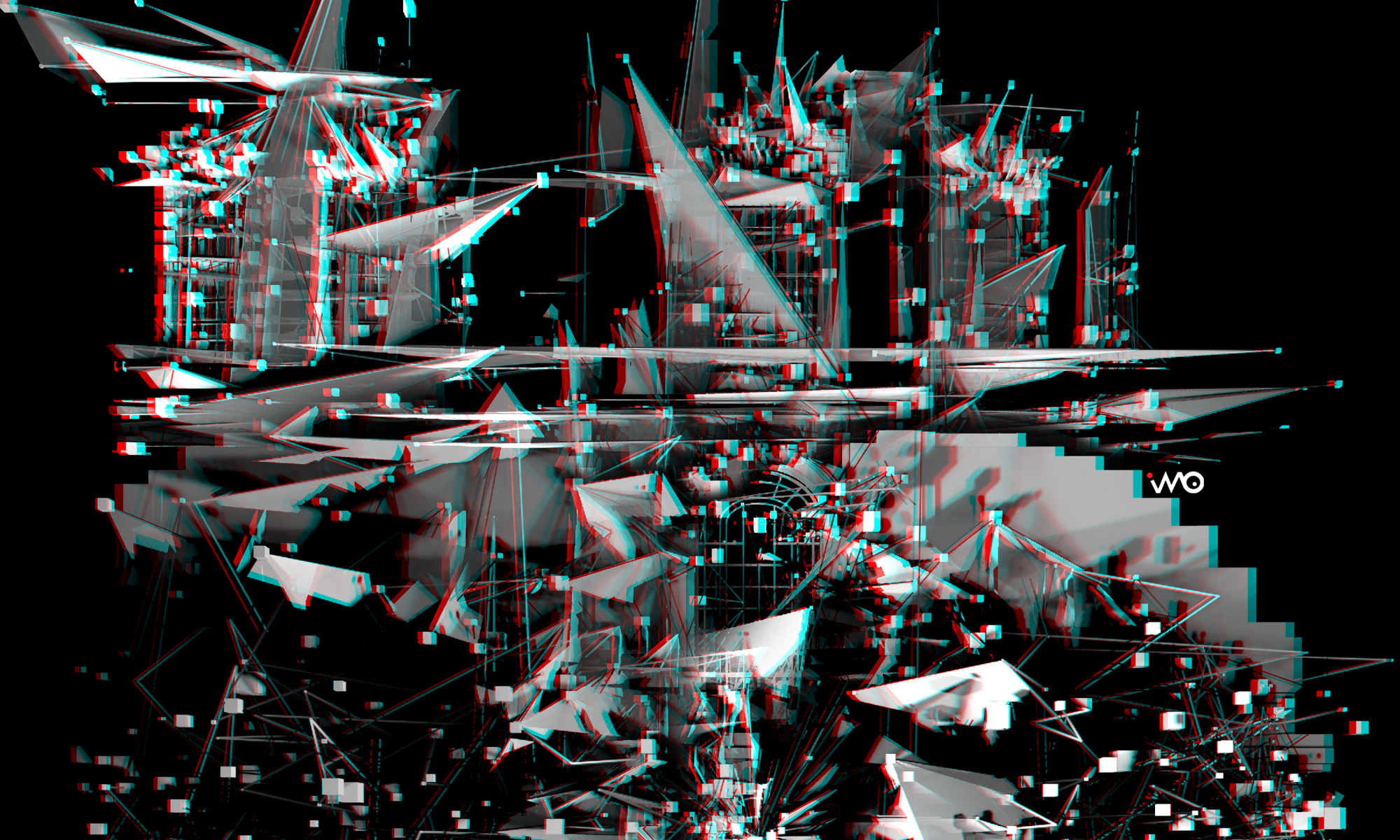
‘TESSELA’ — Object-projection-mapping | Application essay, 2026
The Digital Afterlife of Trompe-l’œil: Reverse Perspective, Op-Art, and Immersive Projection
Works situated at the intersection of visual art and perceptual science rarely emerge from a neutral theoretical position. The installation discussed here — a synthesis of a wall-mounted object built on the principle of reverse perspective and a projected animation — takes as its starting point the question that Op Art posed to contemporary artistic discourse in the mid-1960s: what does the eye see, and what does the brain construct? That question has not been resolved. It has simply changed medium.
I. Reconfiguring Trompe-l’œil: Projection Technique and Optical Deception
Trompe-l’œil — “deceiving the eye” — entered art history as a baroque optical device: painted stone, illusionistic ceilings, objects escaping their frames. Projection mapping reframes that gesture entirely. Rather than painting an illusion onto a surface, it casts real-time visual information onto a physically distorted object — where the carrier itself is active: the object’s geometry is an integral part of the illusion, not merely a passive canvas. In the planned installation, this dual structure is decisive: a relief cube-form protrudes physically from the wall, while the perspective animation projected onto it implies the opposite direction as the viewer moves. The eye perceives convexity; the projected image asserts concavity. This is not a technical trick — it is a structural account of perceptual deception.
British painter Patrick Hughes formulated the principle of reverse perspective in 1964: perspective scenes painted onto pyramid-shaped reliefs, in which the physically nearest point appears furthest in the image. A viewer moving through the exhibition space experiences the effect immediately: the apparently static surface “follows” the viewer, rotates, lives. The phenomenon is grounded in proprioceptive conflict (sensorimotor conflict*) — positional signals from the limbs and signals from the visual system contradict each other, and the brain resolves the discrepancy by constructing movement where there is none. Projection technique layers this effect further: the animated content does not simply conform to the object’s surface; it manages it dynamically. The movement now has two sources: the viewer walks, and the image changes.
*Sensorimotor conflict: The phenomenon is grounded in the collision between motion parallax and stereoscopic depth cues. As the viewer moves, the visual system expects nearby points to shift faster across the visual field than distant ones. Because the physical form is inverted, the brain can resolve the contradictory spatial signals in only one way: it ‘decides’ that the object is rotating.

II. Vasarely’s Legacy: The Quasi-Moving Image and the Genealogy of Digital Immersion
Victor Vasarely — born in Pécs and shaped at the Budapest Bauhaus-tradition Műhely academy — did not simply make “moving images” as a central figure of the Op Art movement. He brought the viewer into the active structure of the work. The spherical grids of the Vega series, the simultaneously convex and concave reading of the Kepler cube, the rhombus systems opened up visual spaces carrying no narrative content yet producing strong affective responses. The 1965 MoMA exhibition The Responsive Eye was a watershed: the image does not represent — it operates. By directly engaging perceptual mechanisms, Vasarely anticipated what we now call immersive experience.
The projected content of the planned installation brings this logic into physical space: the rhombic cube grid — synthesised through a Python-based generative procedure (see appendix) — performs a Vasarely-type distortion, but now not on a plane, rather on the surface of a physically protruding object. The 2D grid animation and the 3D carrier together produce the paradoxical percept that Vasarely resolved within the boundaries of painting. The transition is not a mere change of medium: the movement is real, the illusion remains sustainable, the image physically extends toward the viewer. That responsive quality — which Seitz identified as early as 1965 — has become a real-time dialogue with architecture and with the body.
III. Constructivist Foundation, Phenomenological Projection
Constructivism — Moholy-Nagy, El Lissitzky, the Bauhaus spatial programme — understood geometry not as aesthetic style but as an ontological project: the systematic investigation of relations between space, light, and form. The work discussed here draws on that tradition and explicitly invokes its formal vocabulary, but the cube, the rhombus, the edge, and the perspective are not decorative elements — they are instruments for examining spatial perception. If a philosophical coordinate is required, Maurice Merleau-Ponty’s Phénoménologie de la perception (1945) provides the most productive frame: the body is not a passive observer of space but its constitutive participant. Reverse perspective destabilises precisely that expectation or convention: the experience the body anticipates does not arrive; something else comes in its place. The installation is not about what the viewer sees, but about what the viewer expects — and what fails to materialise.
Donald Judd’s concept of the “specific object” is also relevant here, but with an inverted sign. Judd programmatically expelled illusion: the object is itself, neither painting nor sculpture, simply real material in real space. The work planned here deliberately complicates that position: the object is double-faced. Without projection it stands as a geometric wall relief — specific in Judd’s sense. With projection, the illusion reconstitutes the very space Judd excluded. This is not a refutation — it is a dialogue between two defining positions from two distinct moments.
IV. Hommage and Actuality: Why This Work, Now?
As a practitioner working in architectural projection and immersive spatial design, this project is a personal, focused research process: a visual experiment concentrated on a single projector and a single physical object. Over the past two decades of mapping practice, the genre’s priorities have shifted considerably. In the process, the fundamental perceptual question — how can the spatial reading of an object be manipulated through projection? — has in many cases been reduced to a mere instrument, an end-in-itself visual spectacle, in place of sustained investigation. This work returns precisely to that foundational question, establishing the conditions for clear and unobstructed observation.
Returning to the legacy of Op Art is, in this context, a methodological decision, not nostalgia. Vasarely demonstrated that with geometric means — the most reductive visual material available — it is possible to produce strong, complex perceptual experiences. That lesson is often bypassed by digital immersive art in the euphoria surrounding expanding technological possibility. The present installation attempts to bring the two together in a single work: a physical form built from constructivist reduction, and digitally generated, animated Op Art content. The aim is not beauty — the aim is for the object to override the viewer’s spatial certainties.
In the context of digital media art, media aesthetics and perceptual research appear as a deliberately linked programme — such works are justified insofar as technology is a means, not an end. The installation outlined here uses projection technique for what it does best: to put the physical reality of an object in question. Is what appears solid actually solid? Does what protrudes actually recede? The viewer, in the act of walking, enters the position of the experimental subject — a position that, through Vasarely and Hughes, reaches back at least sixty years.
Supplementary chapter — the mathematical and visual genealogy of the projection object
V. From Tessellation to Projection Object: Dunham, the Hyperbolic Plane, and Implemented Geometry
In 2010, Douglas Dunham, a mathematician at the University of Minnesota Duluth, published a paper at the Bridges Conference — held that year in Pécs, Vasarely’s birthplace — that reinterpreted the Hungarian artist’s cube-grid patterns within hyperbolic geometry. The title: Hyperbolic Vasarely Patterns. This academically framed work laid out precisely the mathematical logic that the installation presented here — through a generative C4D Python script — realises as a three-dimensional projection object. The connection is not coincidental: in tracing the genealogy of the project, Dunham’s paper is one of its most precise theoretical antecedents.

What Dunham Did: The Square Curves, But Stays the Same Size
It is worth going back to first principles. Vasarely worked on the Euclidean plane: he distorted a square grid to create the impression of a sphere. The grid rows are straight lines, but the cubes compress toward the edges and “bulge” in the centre. That is the essence of the Vega series — a purely visual illusion achieved through perspectival distortion, not geometric transformation. Dunham’s question was different: what happens if the distortion is not a painterly device, but follows from the actual curvature of space?
In hyperbolic geometry — specifically in the Poincaré disk model — every unit is the same size, but in the model’s representation each unit appears progressively smaller as it approaches the boundary circle. This means that a grid of equal-sided squares inside the disk looks exactly like a Vasarely Vega pattern: the central cells are large, the peripheral ones compress. But there is no deception here: the curvature is real, the cells are hyperbolically equal. Dunham calls this structure a “{p,q} tessellation” — where p is the number of sides and q the number of faces meeting at each vertex. The Vasarely-type cube grid corresponds to the {4,4} Euclidean tessellation; Dunham investigates the {4,5} and {4,6} hyperbolic variants.
The hexagonal cube-grid pattern — which Vasarely also used extensively and which forms the basic motif of the present installation — appears in Dunham as the hyperbolic extension of the {6,3} Euclidean tessellation, in the {6,4} subdivision. In this structure, hexagons composed of three rhombi tile the plane such that the three faces receive different illumination — dark, medium, light — and the result is the illusion of an isometric cube projection. Dunham notes that the hyperbolic version is less visually successful because adjacent rhombi sometimes receive the same shade. This problem is resolved precisely and elegantly in the generative implementation discussed below.
Between Square and Circle: What the Python Script Implements
The generative script running in C4D — whose output is simultaneously the exhibition object and the surface that receives the projected content — realises exactly the mathematical transition that Dunham discusses at a theoretical level. It is worth following this step by step, because the implementation is elegant and the final result — the installation’s 3D form — follows directly from it.
The script begins with a hexagonal cube grid: for every integer value combination of the three-axis coordinate system (i, j, k) where i+j+k=0, one cube is placed in space. This is the standard isometric cube grid, which the programme then transforms in two stages. First it projects the 3D cubes onto a plane from the viewpoint direction — this is the transform_to_front() function, which applies the isometric axonometric matrix. The result is exactly the 2D cube grid seen in Vasarely’s paintings, and which the attached Python animation generates.
The second transformation is the key step. The script “curves” the projected plane points in two distinct ways:
The first is hyperbolic compression: the distance of each point from the centre is transformed using the formula math.tanh(r / compress_scale). This is precisely the distortion of the Poincaré disk model — the central cubes appear at large scale, the peripheral ones compress together, but hyperbolically each is identical. This produces the “global bulge beneath the surface” effect of the Vega series.
The second is square-to-circle morphing: the blend parameter governs how far the distorted points follow the circular hyperbolic distortion as opposed to the square, axis-aligned distortion. At the centre (blend=1.0) the form is fully circular; toward the edges (where falloff reduces the blend value) it becomes progressively more angular. Dunham examined exactly these two modes side by side — the circle-based {4,5}/{4,6} and the square-based cube pattern. The script handles both within a single continuum, adjustable at runtime.
Note for the embedded p5.js simulation: these two parameters — blend and compress_scale — are the primary interactive axes. Moving between blend=0 (pure square tessellation) and blend=1 (full Poincaré-disk mapping) makes the Dunham–Vasarely transition directly observable in real time.

The Plane Rises: The Bell Curve and the Physical Object
Dunham’s paper remains two-dimensional: the patterns appear within the Poincaré disk as planar figures. The decisive step of the installation is to lift the mathematical structure into a third dimension, thereby creating a projection surface from it. This is achieved by the bell_curve extrusion mechanism.
For each point — each vertex of the hexagonal cube grid — the programme calculates how far it “protrudes” from the wall. The degree of protrusion varies according to a cosine bell curve: the vertices of the central cubes protrude maximally (z_max_extrusion), those of the peripheral cubes settle back flush with the wall. The programme further distinguishes the cube’s “apex” — where all three faces meet — from the remaining points: apexes protrude more strongly (z_max_extrusion), other points less so (z_base_extrusion). This produces the physical object’s faceted yet continuous spherical surface — visible in the attached exhibition renders.
The result is a wall object whose surface physically maps the distortion that Vasarely simulated painterly and that Dunham situated mathematically within the curvature of the Poincaré disk. The object is therefore not a carrier of a Vasarely pattern — it is itself a Vasarely pattern, written in material form. The projection activates this structure: the animated 2D generative image — itself the planar projection of the same mathematics — fits precisely onto the UV coordinates of the 3D surface, because the script derives both from the same flat_points projection basis. The 2D content and the 3D form are mathematically coherent: two distinct manifestations of the same system of equations.


What This Work Adds: The Convergence of Three Levels
Dunham’s paper remained theoretical: it depicted on the hyperbolic plane what Vasarely painted on the Euclidean plane. The installation inserts a third level into this relationship: physical space. The three levels — Vasarely’s Euclidean illusion, Dunham’s hyperbolic mathematics, the projection object’s spatial reality — meet in a single work.
This is also precisely articulable technically. The tanh-compression the programme applies is a discrete approximation of the conformal mapping of the Poincaré disk. The blend parameter interpolates between circular and square symmetry — pressing exactly the question Dunham addresses when comparing circular versus angular structures within {4,p} and {6,p} tessellations. The bell-curve extrusion implements the Hughes reverse-perspective mechanism: the physically protruding central section appears “concave” under the effect of the projected distortion. The three systems — hyperbolic geometry, Op Art visuality, reverse-perspective psychology — coexist within a single generative parameter space.
In this sense the object does not illustrate the work of Dunham or Vasarely — it continues it: with tools unavailable in 2010, and in a medium — the intersection of projection technology and real-time generative geometry — that neither Vasarely nor Dunham examined. In the context of the Bridges Conference and the Vasarely Museum in Pécs, this is a legible continuation of a shared genealogy. The work is a contribution to that tradition, not an epigone of it but its next step.
Ivó Kovács — Budapest, April 2026 — ivo3d.com
References
[1] D. Dunham, Hyperbolic symmetry, Computers & Mathematics with Applications, Vol. 12B, Nos. 1/2,
1986, pp. 139–153. Also appears in the book Symmetry edited by István Hargittai, Pergamon Press, New
York, 1986. ISBN 0-08-033986-7
[2] M. Vasarely, Official Vasarely web site at: http://www.vasarely.com/
[3] V. Vasarely, Vasarely I, II, III, IV (Plastic Arts of the Twentieth Century), Editions du Griffon Neuchatel,
1965, 1971, 1974, 1979. ASIN’s: B000FH4NZG, B0006CJHNI, B0007AHBLY, B0006E65FY
[4] https://archive.bridgesmathart.org/2010/#gsc.tab=0