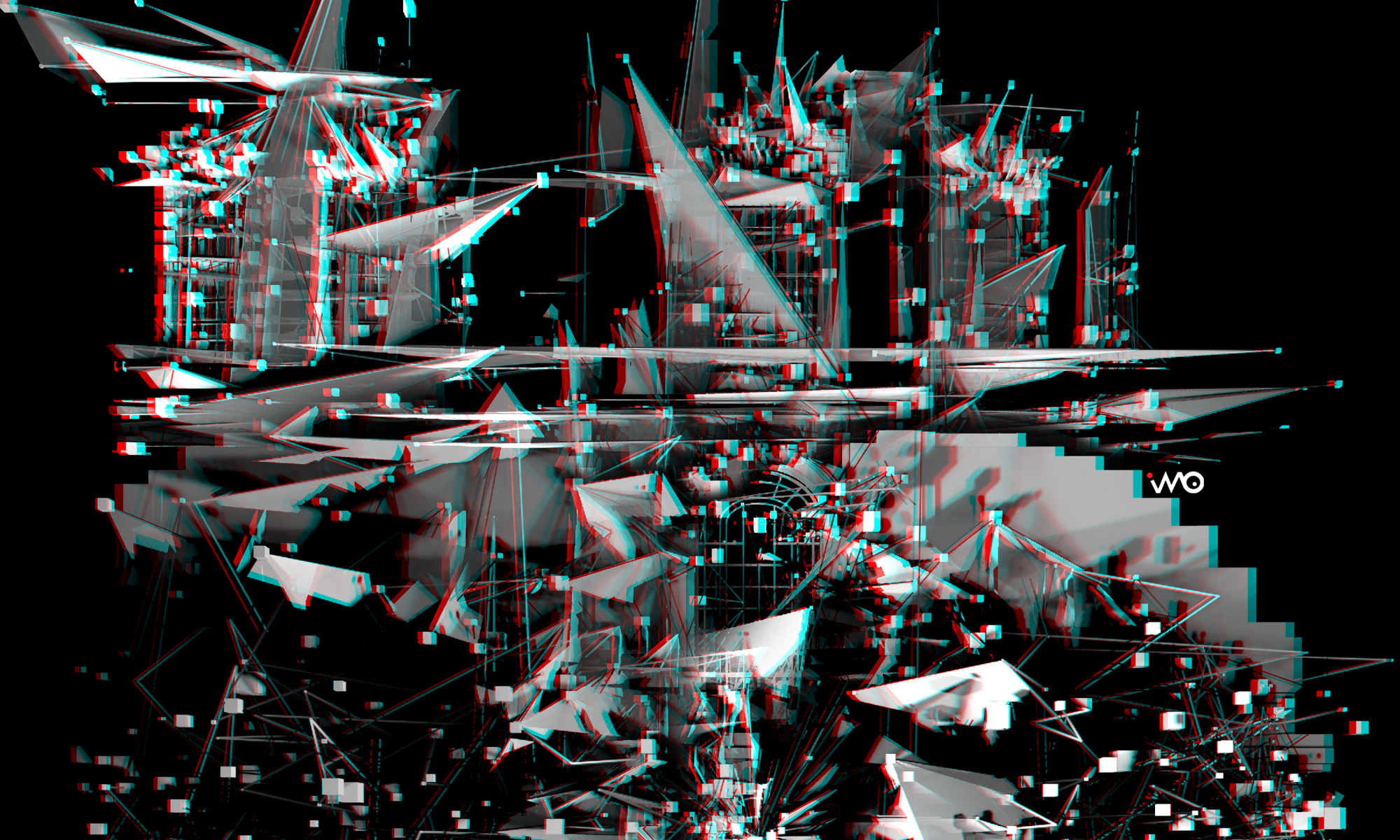
LIQUID HORIZONS โ€” Ivรณ Kovรกcs | 360ยฐ Immersive Video Installation

LIQUID HORIZONS โ€” an immersive video installation (at Fixir Gallery, Veszprem)
by Ivรณ Kovรกcs, reconstructed as a fully navigable 360ยฐ space.

In its physical form, the work encloses the visitor in a 4.2 ร— 4.2 m room of four seamless projected walls โ€” a single, uninterrupted synthetic space with no doors, no paths, no horizon to hold on to. The viewer’s own body becomes the only fixed point of reference.

Six scenes unfold without narrative โ€” glitch corridor, brutalist labyrinth, biological vein networks, geometric core, spectral veils, liquid-architecture, synthetic horizons โ€” juxtaposing Trauma-Arbeit and utopia in a digital realm, somewhere between architectural critique and algorithmic aesthetics.

This 360ยฐ version was rebuilt in TouchDesigner and rendered in 8K from the exact center of the room โ€” on the one spot where visitor could stand.

๐ŸŽง Use headphones. ๐Ÿ“ฑ Drag the screen or move your phone to look around. ๐Ÿฅฝ Best experienced in a VR headset in 8K.

Video: Ivรณ Kovรกcs
Music: Jรณzsef Iszlai
Year: 2026 | Duration: 17:16
Made with: Notch, Stable Diffusion, 3D simulation, TouchDesigner
More: https://3dvideomapping.net/art/installation-art/2026-liquid-horizons/ | https://liquid.ivo3d.com

#360video #VR #videoart #8K #immersive #newmediaart #videoinstallation #ivo3d #generativeart #digitalart #audiovisual #syntheticspaces #liquidhorizons #immersiveart #mediaart #fixir
#comfyui

ARTIST TALK โ€” LIQUID HORIZONS

ARTIST TALK โ€” LIQUID HORIZONS
๐Ÿ“ f|x|r galรฉria, Veszprรฉm, Vรกr โ€“ Foton udvar
๐Ÿ—“ Saturday, July 18 ยท 7 PM


This Saturday I’ll be talking about Liquid Horizons โ€” the immersive four-wall panoramic installation currently on view at f|x|r galรฉria โ€” and the process behind it: AI-generated imagery, projection, and the shifting horizon between the real and the synthetic image.


Can’t make it in person? Step into the virtual gallery here:
๐ŸŒŠ https://liquid.ivo3d.com

Join us โ€” the conversation is open to everyone.
Event details: https://www.facebook.com/events/1702583830854832/

I generated an audio companion โ€” a scene-by-scene author’s narration on the ideas behind the work.
“The machine writes and reads everything now; understanding is still ours.”
Listen below
๐ŸŽง HU:

๐ŸŽง EN:

๐ŸŽง DE:

See you there…

Tessela – 2D version

‘Tessela’ – difraction version (hommage รก Vasarely: Vega series, p5js version of the interactivity)

‘tessela’ – searchlight version

f|x|r 3D-Gallery-view

Just a quick minisite release for the upcoming (Liquid-horizons) exhibition at f|x|r gallery:
(3d teaser)

liquid.ivo3d.com

and a new article at kultura.hu

What Does It Mean to Be Inside an Image?

On immersion, presence, and why the frame had to disappear

Ivรณ Kovรกcsย  ยทย  ivo3d.com

From 19th-century panoramas to architectural video mapping: media artist Ivo Kovรกcs traces the history and theory of immersion and spatial presence.

I have spent the better part of two decades projecting light onto surfaces that were never designed to receive it โ€” cathedral facades, purpose-built sculptural objects, civic walls in the middle of the night. What keeps drawing me back to this practice is a question I have never fully resolved: at what point does a viewer stop looking at an image and start being inside one?

This is not a new question. It is, in fact, one of the oldest ambitions in the history of art.

Long before digital projectors existed, panorama painters in 19th-century London and Paris were building circular rotundas designed to suppress the edge of the canvas entirely. Visitors descended into a darkened room and found themselves, apparently, standing on a hilltop overlooking a battlefield or a city skyline. The frame had disappeared. What remained was the sensation of being there. We call this immersion โ€” and its logic has not fundamentally changed in two hundred years, even as its technical means have transformed beyond recognition.

What has changed is the relationship between the image and time. The painted panorama was static; you could look, but you could not influence what you saw. Contemporary immersive environments โ€” responsive, generative, computationally alive โ€” are constituted by the viewer’s presence within them. The work does not exist in a fixed state. It becomes itself through the body moving through it.

This shift carries theoretical weight. When Maurice Merleau-Ponty argued that the body does not observe space but inhabits it, he was describing something that immersive art now literalises: the dissolution of the distance between perceiver and perceived. Scale, acoustic depth, responsive light โ€” these are not decorative tools. They are the architecture of a different kind of attention.

Over the years I have tried to map this territory through my own practice โ€” at competition facades, at medieval churches, at purpose-built installations โ€” and through the theoretical frameworks that help me understand what I am actually doing when I ask a viewer to surrender their sensory horizon.

The Q&A below is an attempt to make that map legible.

โ†’ย  Read: The Architecture of Experience โ€” 10 Questions on Immersion