
text, video: Ivó Kovács
music: József Iszlai
Essay about the upcoming immersive video-installation at gallery f|x|r
Synthetic Horizons — On the Ontology of Computed Space
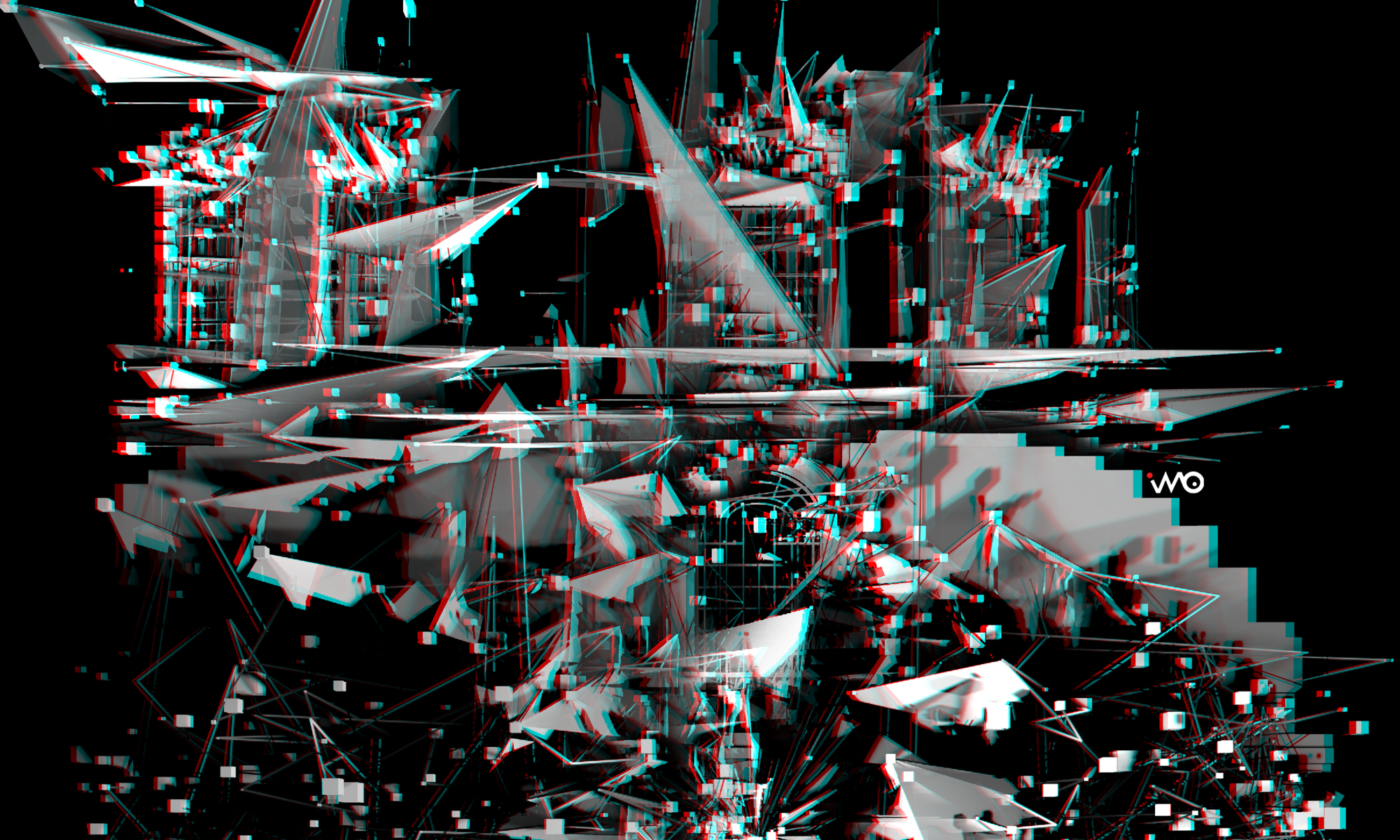
Liquid Horizons investigates the ontology of computed space: the condition in which a digital environment is no longer a representation of physical reality but an autonomous, self-generating field. Its looped panoramic field — built from six visual stations — follows no narrative. The glitch-laden digital threshold, the brutalist concrete labyrinth, the AI-generated biological vascular network, the pure geometric order, the spectral veils and the synthetic horizon do not supersede one another: they coexist as equal aggregates, folding into a single continuous event.

At the centre of the work stands the question of the oneiric sublimation of trauma. The brutalist scenes of the projection — mirrored concrete stairwells, unfinished stadium interiors, corridors that lead nowhere — carry the architectural imprint of contemporary wartime destruction: an algorithmic monument to the suspended future. Not as documentation but as weightless data-flow — the software does not depict the destruction; it dreams it. Through this digital Traumarbeit, raw concrete is transmuted into a pulsating network, then into pure geometric order, and finally sublimated into the light-saturated data-aesthetics of the computational sublime — without the loop offering redemption. The cycle closes on itself.

In Vilém Flusser’s terms of the technical image: the light here does not arrive from sunlight but from global illumination algorithms; the texture of the canvas is definitively replaced by the texture of shader code. Through Gilles Deleuze’s Le Pli (The Fold): matter is not a static object but an infinitely modulable event — brutalist enclosure and liquid freedom constitute a single topological unity. In Marcos Novak’s liquid architecture: digital space severs its relationship with gravity and function to become pure mathematics and sensation.

The work’s visual register is determined by three distinct image-making logics in simultaneous operation: real-time rendering (NotchVFX), AI-mediated style transfer (Stable Diffusion), and digitally processed built spaces. There is no sharp boundary between the three layers — and this is itself the work’s argument: in the era of the computed image, the distinction between ‘manual’ and ‘automatic’ image-making ceases to hold.

After the model of Marc Augé’s non-places: the projected environment withholds every conventional marker of human orientation. There is no door, no path, no graspable surface. The visitor’s own body remains the sole subjective fixed point within this amorphous, post-anthropocentric data-landscape — whose horizon does not separate sky from earth but unifies them as a data-plane.

360° immersive video installation — 17ʹ 20ʺ videoloop, — f|x|r galéria — 05.08.2026 — location: Vár u. 17., Veszprém, Hungary, Europe